<?xml version="1.0"?>
<!DOCTYPE html    PUBLIC "-//W3C//DTD XHTML 1.1 plus MathML 2.0//EN"
           "http://www.w3.org/Math/DTD/mathml2/xhtml-math11-f.dtd">
<html xmlns="http://www.w3.org/1999/xhtml">
<head>
<meta name="GENERATOR" content="TtM 3.72" />
 <style type="text/css">
 div.p { margin-top: 7pt; }
 span.roman {font-family: serif; font-style: normal; font-weight: normal;} 
</style>

                                                        <a name="firstpage">
</a> 
<title> \ohead  </title>
</head>
<body>
 
<h1 align="center">Parameter Estimation for Biochemical Reactions in Phototransduction </h1>

<h3 align="center">Vasilios Alexiades<br /><br />
Department of Mathematics, University of Tennessee Knoxville, TN 37996<br />
and <br />
Oak Ridge National Laboratory, Oak Ridge TN 37831, USA </h3>


<div class="p"><!----></div>

<h2> Abstract</h2>
 Vision begins when photons are captured by rhodopsin 
molecules in photoreceptor cells in the back of the retina.  Activation 
of rhodopsin instigates a cascade of biochemical reactions, which
eventually results in reduction of the steady (dark) current across
the photoreceptor plasma membrane.  This is the photoreceptor response,
the signal that propagates to the brain enabling vision.

<div class="p"><!----></div>
Employing an existing model for the biochemical cascade and the 
response, expressed as a system of ordinary differential equations
involving 16 parameters, we present an approach based on statistical 
sensitivity/uncertainty analysis and optimization, 
to find parameters that produce a response matching experimental data.  


<div class="p"><!----></div>
 <b>AMS (MOS) Subject Classification</b>. 92C45, 90C31, 62J02.

<div class="p"><!----></div>

 <h2><a name="tth_sEc1">
1</a>&nbsp;&nbsp;INTRODUCTION</h2><a name="S:1">
</a>
Phototransduction is the process by which light is converted into an
electrical response, in rod and cone photoreceptors in the retina.
A model for the cascade of biochemical reactions, and the ensuing
photoreceptor response, in rod photoreceptors of vertebrates has 
been developed by (Hamer et al., 2003).
The cascade is described by 66 reactions involving 16 primary 
parameters. The reactions can be translated into a system of 
nonlinear ordinary differential equations (ODEs),
with coefficients involving the parameters (reaction rates). 

<div class="p"><!----></div>
Our goal is to find parameter values that produce a response 
matching experimental data. This is a difficult, inverse
(hence ill-posed) problem that can be viewed as a multi-objective
optimization problem.

<div class="p"><!----></div>
We employ a combination of statistical and optimization approaches 
and tools to treat this parameter estimation problem. 
To reduce the large 16-parameter search space, we use statistical 
sensitivity analysis to identify the 4 most influential parameters
over which to optimize. To find "promising" starting values, we
use statistical sampling methods (Random and Lp-Tau, often employed
for uncertainty quantification).  Evaluation of the cost function
requires execution of the forward model simulating the phototransduction
process; thus we must employ an efficient, derivative-free, nonlinear
optimizer.  It turns out that the cost function is extremely "bumpy"
with multiple local minima. Nevertheless, we manage to identify
(several) parameter sets that produce responses reasonably close 
to experimental data.

<div class="p"><!----></div>
In &#167;<a href="#S:2">2</a> we briefly describe the phototransduction process,
the cascade of biochemical reactions, and the photoreceptor response.
In &#167;<a href="#S:3">3</a> we raise the issues arising in parameter optimization,
which are addressed in &#167;<a href="#S:4">4</a>. We conclude with a summary in 
&#167;<a href="#S:5">5</a>.

<div class="p"><!----></div>

 <h2><a name="tth_sEc2">
2</a>&nbsp;&nbsp;PHOTOTRANSDUCTION</h2><a name="S:2">
</a>
Vision begins at photoreceptor cells in the back of the retina.  
Photons are captured by rhodopsin molecules located on "discs"
(bilipid membranes) in the outer segment of (rod) photoreceptors. 
Activation of rhodopsin instigates a cascade of biochemical reactions
(described below), the end product of which is production of PDE
<math xmlns="http://www.w3.org/1998/Math/MathML">
<mrow>
<msup><mrow></mrow><mrow><mo>*</mo></mrow>
</msup>
</mrow></math>
(activated <i>phosphodiestarase</i>). PDE
<math xmlns="http://www.w3.org/1998/Math/MathML">
<mrow>
<msup><mrow></mrow><mrow><mo>*</mo></mrow>
</msup>
</mrow></math>hydrolyzes cGMP
(cyclic guanosime monophosphate), which diffuses in the cytosol  
surrounding the discs, reducing its concentration.
The decrease of cGMP causes closure of some of the cGMP-gated channels 
on the plasma membrane of the photoreceptor, resulting in lowering
the influx of positive ions, in particular Ca
<math xmlns="http://www.w3.org/1998/Math/MathML">
<mrow>
<msup><mrow></mrow><mrow><mn>2</mn><mo>+</mo></mrow>
</msup>
</mrow></math>, thus lowering 
the local current 
<math xmlns="http://www.w3.org/1998/Math/MathML">
<mrow><mi>J</mi></mrow></math> across the plasma membrane.
In darkness, the channels are open allowing influx of ions and a
steady <i>dark current</i> 
<math xmlns="http://www.w3.org/1998/Math/MathML">
<mrow>
<msub><mrow><mi>J</mi></mrow><mrow><mi>drk</mi></mrow>
</msub>
</mrow></math>&nbsp;is maintained by the 
Na
<math xmlns="http://www.w3.org/1998/Math/MathML">
<mrow>
<msup><mrow></mrow><mrow><mo>+</mo></mrow>
</msup>
</mrow></math>/K
<math xmlns="http://www.w3.org/1998/Math/MathML">
<mrow>
<msup><mrow></mrow><mrow><mo>+</mo></mrow>
</msup>
</mrow></math>/Ca
<math xmlns="http://www.w3.org/1998/Math/MathML">
<mrow>
<msup><mrow></mrow><mrow><mn>2</mn><mo>+</mo></mrow>
</msup>
</mrow></math> exchanger. The reduction in current,

<math xmlns="http://www.w3.org/1998/Math/MathML">
<mrow>
<msub><mrow><mi>J</mi></mrow><mrow><mi>drk</mi></mrow>
</msub>
<mo>-</mo><mi>J</mi></mrow></math>, known as the <b>response</b>, is the signal that 
propagates to the brain enabling us to see.

<div class="p"><!----></div>
Thus, the phototransduction process consists of two stages.
The first stage is the cascade of biochemical reactions, 
leading from a photon captured by a rhodopsin molecule on a disc 
at time 
<math xmlns="http://www.w3.org/1998/Math/MathML">
<mrow><mi>t</mi><mo>=</mo><mn>0</mn></mrow></math> to production of activated PDE, 
<math xmlns="http://www.w3.org/1998/Math/MathML">
<mrow>
<msup><mrow><mi>PDE</mi></mrow><mrow><mo>*</mo></mrow>
</msup>
<mo stretchy="false">(</mo><mi>t</mi><mo stretchy="false">)</mo></mrow></math>&nbsp;, at time 
<math xmlns="http://www.w3.org/1998/Math/MathML">
<mrow><mi>t</mi><mo>&gt;</mo><mn>0</mn></mrow></math>. 
The entire cascade takes place on the activated disc.
The second stage takes place in the cytosol surrounding the discs.
Its input is 
<math xmlns="http://www.w3.org/1998/Math/MathML">
<mrow>
<msup><mrow><mi>PDE</mi></mrow><mrow><mo>*</mo></mrow>
</msup>
<mo stretchy="false">(</mo><mi>t</mi><mo stretchy="false">)</mo></mrow></math>&nbsp;and, via diffusion of cGMP and Ca
<math xmlns="http://www.w3.org/1998/Math/MathML">
<mrow>
<msup><mrow></mrow><mrow><mn>2</mn><mo>+</mo></mrow>
</msup>
</mrow></math> in the
cytosol, results in drop of ionic current across the plasma membrane,
measured by the 
<br />
<table width="100%"><tr><td align="center">
    <math xmlns="http://www.w3.org/1998/Math/MathML">
    <mstyle displaystyle="true"><mrow><mi fontweight="bold">relative</mi><mi fontweight="bold">&nbsp;</mi><mi fontweight="bold">response</mi><mi>&emsp;&emsp;&emsp;&emsp;&emsp;&emsp;</mi><mrow><mstyle fontfamily="helvetica"><mi fontstyle="italic">R</mi></mstyle></mrow>
<mo stretchy="false">(</mo><mi>t</mi><mo stretchy="false">)</mo><mi>&nbsp;</mi><mo>=</mo><mn>1</mn><mo>-</mo><mi>J</mi><mo stretchy="false">(</mo><mi>t</mi><mo stretchy="false">)</mo><mo stretchy="false">/</mo>
<msub><mrow><mi>J</mi></mrow><mrow><mi>drk</mi></mrow>
</msub>
<mi>&ensp;</mi><mo>,</mo></mrow>
    </mstyle></math></td><td width="1">
    <math xmlns="http://www.w3.org/1998/Math/MathML">
    <mstyle displaystyle="true"><mrow><mo stretchy="false">(</mo><mn>1</mn><mo stretchy="false">)</mo></mrow>
    </mstyle></math>
</td></tr></table>

<a name="eq:response">
</a>
expressed in percent (of 
<math xmlns="http://www.w3.org/1998/Math/MathML">
<mrow>
<msub><mrow><mi>J</mi></mrow><mrow><mi>drk</mi></mrow>
</msub>
</mrow></math>&nbsp;). 

<div class="p"><!----></div>

     <h3><a name="tth_sEc2.1">
2.1</a>&nbsp;&nbsp;Biochemical cascade</h3><a name="S:2.1">
</a>
The most detailed model for the cascade of reactions was developed 
by (Hamer et al., 2003).	It incorporates multi-stage shutoff of activated rhodopsin and 
consists of 66 biochemical reactions, shown below.

<div class="p"><!----></div>
<a name="">
</a><br />
<table width="100%"><tr><td align="center">
    <math xmlns="http://www.w3.org/1998/Math/MathML">
    <mstyle displaystyle="true"><mrow>
<msubsup><mrow><mi>R</mi></mrow><mrow><mi>n</mi> </mrow>
<mrow><mo>*</mo></mrow></msubsup>
<mo>+</mo><mi>RK</mi>
\underset
<msub><mrow><mi>k</mi></mrow><mrow><mi>RK</mi><mn>1</mn></mrow>
</msub>
<mo stretchy="false">(</mo><mi>n</mi><mo stretchy="false">)</mo>
\overset
<msub><mrow><mi>k</mi></mrow><mrow><mi>RK</mi><mn>2</mn></mrow>
</msub>
<mo>&rightleftharpoons;</mo>
<msubsup><mrow><mi>R</mi></mrow><mrow><mi>n</mi> </mrow>
<mrow><mo>*</mo></mrow></msubsup>
<mo>&bullet;</mo>
<msub><mrow><mi>RK</mi></mrow><mrow><mi>pre</mi></mrow>
</msub>
<mi>&ensp;</mi><mo>,</mo><mi>&emsp;&emsp;</mi><mi>n</mi><mo>=</mo><mn>0</mn><mo>,</mo><mo>.</mo><mo>.</mo><mo>.</mo><mo>,</mo><mn>7</mn><mo>.</mo><mi>&emsp;</mi><mi>&emsp;</mi>
<msub><mrow><mi>k</mi></mrow><mrow><mi>RK</mi><mn>1</mn><mo stretchy="false">(</mo><mi>n</mi><mo stretchy="false">)</mo></mrow>
</msub>
<mo>=</mo>
<msub><mrow><mi>k</mi></mrow><mrow><mi>RK</mi><mn>1</mn><mo stretchy="false">(</mo><mn>0</mn><mo stretchy="false">)</mo></mrow>
</msub>
<mi>&ensp;</mi>
<msup><mrow><mi>e</mi></mrow><mrow><mo>-</mo><mi>&omega;</mi><mi>n</mi></mrow>
</msup>
<mi>&ensp;</mi><mo>,</mo><mi>&emsp;</mi><mi>n</mi><mo>=</mo><mn>1</mn><mo>,</mo><mo>.</mo><mo>.</mo><mo>.</mo><mo>,</mo><mn>7</mn><mo>.</mo></mrow>
    </mstyle></math>
</td></tr></table>
<br />

<table width="100%"><tr><td align="center">
    <math xmlns="http://www.w3.org/1998/Math/MathML">
    <mstyle displaystyle="true"><mrow>
<msubsup><mrow><mi>R</mi></mrow><mrow><mi>n</mi> </mrow>
<mrow><mo>*</mo></mrow></msubsup>
<mo>&bullet;</mo>
<msub><mrow><mi>RK</mi></mrow><mrow><mi>pre</mi></mrow>
</msub>
<mo>+</mo><mi>ATP</mi>
\overset
<msub><mrow><mi>k</mi></mrow><mrow><mi>RK</mi><mn>3</mn></mrow>
</msub>
<mo stretchy="false">(</mo><mi>n</mi><mo stretchy="false">)</mo><mo>&rarr;</mo>
<msubsup><mrow><mi>R</mi></mrow><mrow><mi>n</mi><mo>+</mo><mn>1</mn> </mrow>
<mrow><mo>*</mo></mrow></msubsup>
<mo>&bullet;</mo>
<msub><mrow><mi>RK</mi></mrow><mrow><mi>post</mi></mrow>
</msub>
<mo>+</mo><mi>ADP</mi><mi></mi><mo>,</mo><mi>&ensp;</mi><mi>&ensp;</mi><mi>&ensp;</mi><mi>n</mi><mo>=</mo><mn>0</mn><mo>,</mo><mo>.</mo><mo>.</mo><mo>.</mo><mo>,</mo><mn>7</mn><mo>,</mo><mi>&emsp;</mi>
<msub><mrow><mi>k</mi></mrow><mrow><mi>RK</mi><mn>3</mn><mo stretchy="false">(</mo><mi>n</mi><mo stretchy="false">)</mo></mrow>
</msub>
<mo>=</mo><mrow><mo>{</mo>
<mtable>
<mtr><mtd columnalign="left"><mrow>
<msub><mrow><mi>k</mi></mrow><mrow><mi>RK</mi><mn>3</mn><mo stretchy="false">(</mo><mn>0</mn><mo stretchy="false">)</mo></mrow>
</msub>
</mrow></mtd><mtd columnalign="left"><mrow><mi>&ensp;</mi><mi></mi><mo>:</mo><mi></mi><mi></mi>
<mtext> for </mtext> &nbsp; 
<mi>n</mi><mo>&lt;</mo><mn>7</mn></mrow></mtd></mtr>
<mtr><mtd columnalign="left"><mrow><mn>0</mn></mrow></mtd><mtd columnalign="left"><mrow><mi></mi><mi>&ensp;</mi><mo>:</mo><mi></mi><mi></mi>
<mtext> for </mtext> &nbsp; 
<mi>n</mi><mo>=</mo><mn>7</mn></mrow></mtd></mtr></mtable>

<mo> </mo></mrow></mrow>
    </mstyle></math>
</td></tr></table>

<br />
<table width="100%"><tr><td align="center">
    <math xmlns="http://www.w3.org/1998/Math/MathML">
    <mstyle displaystyle="true"><mrow>
<msubsup><mrow><mi>R</mi></mrow><mrow><mi>n</mi><mo>+</mo><mn>1</mn> </mrow>
<mrow><mo>*</mo></mrow></msubsup>
<mo>&bullet;</mo>
<msub><mrow><mi>RK</mi></mrow><mrow><mi>post</mi></mrow>
</msub>
<mo>&rarr;</mo>
<msubsup><mrow><mi>R</mi></mrow><mrow><mi>n</mi><mo>+</mo><mn>1</mn> </mrow>
<mrow><mo>*</mo></mrow></msubsup>
<mo>+</mo><mi>RK</mi><mi>&ensp;</mi><mo>,</mo><mi>&emsp;&emsp;&emsp;</mi><mi>n</mi><mo>=</mo><mn>0</mn><mo>,</mo><mo>.</mo><mo>.</mo><mo>.</mo><mo>,</mo><mn>6</mn><mo>.</mo></mrow>
    </mstyle></math>
</td></tr></table>

<br />
<table width="100%"><tr><td align="center">
    <math xmlns="http://www.w3.org/1998/Math/MathML">
    <mstyle displaystyle="true"><mrow>
<msubsup><mrow><mi>R</mi></mrow><mrow><mi>n</mi> </mrow>
<mrow><mo>*</mo></mrow></msubsup>
<mo>+</mo><mi>Arr</mi><mo>&rarr;</mo>
<msub><mrow><mi>R</mi></mrow><mrow><mi>n</mi></mrow>
</msub>
<mo>&bullet;</mo><mi>Arr</mi><mi>&ensp;</mi><mo>,</mo><mi>&emsp;&emsp;&emsp;</mi><mi>n</mi><mo>=</mo><mn>1</mn><mo>,</mo><mo>.</mo><mo>.</mo><mo>.</mo><mo>,</mo><mn>7</mn><mo>,</mo><mi>&emsp;&emsp;&emsp;</mi>
<msub><mrow><mi>k</mi></mrow><mrow><mi>A</mi><mo stretchy="false">(</mo><mi>n</mi><mo stretchy="false">)</mo></mrow>
</msub>
<mo>=</mo><mi>n</mi><mi>&ensp;</mi>
<msub><mrow><mi>k</mi></mrow><mrow><mi>A</mi><mo stretchy="false">(</mo><mn>1</mn><mo stretchy="false">)</mo></mrow>
</msub>
<mi>&ensp;</mi><mo>,</mo><mi>&emsp;&emsp;&emsp;</mi><mi>n</mi><mo>=</mo><mn>2</mn><mo>,</mo><mo>.</mo><mo>.</mo><mo>.</mo><mo>,</mo><mn>7</mn><mo>.</mo></mrow>
    </mstyle></math>
</td></tr></table>

<br />
<table width="100%"><tr><td align="center">
    <math xmlns="http://www.w3.org/1998/Math/MathML">
    <mstyle displaystyle="true"><mrow>
<msubsup><mrow><mi>R</mi></mrow><mrow><mi>n</mi> </mrow>
<mrow><mo>*</mo></mrow></msubsup>
<mo>+</mo><mi>G</mi><mo>&middot;</mo><mi>GDP</mi><mo>&rarr;</mo>
<msubsup><mrow><mi>R</mi></mrow><mrow><mi>n</mi> </mrow>
<mrow><mo>*</mo></mrow></msubsup>
<mo>&bullet;</mo><mi>G</mi><mo>&middot;</mo><mi>GDP</mi><mi>&ensp;</mi><mo>,</mo><mi>&emsp;&emsp;&emsp;</mi><mi>n</mi><mo>=</mo><mn>0</mn><mo>,</mo><mo>.</mo><mo>.</mo><mo>.</mo><mo>,</mo><mn>7</mn><mo>,</mo><mi>&emsp;&emsp;&emsp;</mi>
<msub><mrow><mi>k</mi></mrow><mrow><mi>G</mi><mn>1</mn><mo stretchy="false">(</mo><mi>n</mi><mo stretchy="false">)</mo></mrow>
</msub>
<mo>=</mo>
<msub><mrow><mi>k</mi></mrow><mrow><mi>G</mi><mn>1</mn><mo stretchy="false">(</mo><mn>0</mn><mo stretchy="false">)</mo></mrow>
</msub>

<msup><mrow><mi>e</mi></mrow><mrow><mo>-</mo><mi>&omega;</mi><mi>n</mi></mrow>
</msup>
<mi>&ensp;</mi><mo>,</mo><mi>&emsp;&emsp;&emsp;</mi><mi>n</mi><mo>=</mo><mn>1</mn><mo>,</mo><mo>.</mo><mo>.</mo><mo>.</mo><mo>,</mo><mn>7</mn><mo>.</mo></mrow>
    </mstyle></math>
</td></tr></table>

<br />
<table width="100%"><tr><td align="center">
    <math xmlns="http://www.w3.org/1998/Math/MathML">
    <mstyle displaystyle="true"><mrow>
<msubsup><mrow><mi>R</mi></mrow><mrow><mi>n</mi> </mrow>
<mrow><mo>*</mo></mrow></msubsup>
<mo>&bullet;</mo><mi>G</mi><mo>&middot;</mo><mi>GDP</mi><mo>&rarr;</mo>
<msubsup><mrow><mi>R</mi></mrow><mrow><mi>n</mi> </mrow>
<mrow><mo>*</mo></mrow></msubsup>
<mo>&bullet;</mo><mi>G</mi><mo>+</mo><mi>GDP</mi><mi>&ensp;</mi><mo>,</mo><mi>&emsp;&emsp;&emsp;</mi><mi>n</mi><mo>=</mo><mn>0</mn><mo>,</mo><mo>.</mo><mo>.</mo><mo>.</mo><mo>,</mo><mn>7</mn><mo>.</mo></mrow>
    </mstyle></math>
</td></tr></table>

<br />
<table width="100%"><tr><td align="center">
    <math xmlns="http://www.w3.org/1998/Math/MathML">
    <mstyle displaystyle="true"><mrow>
<msubsup><mrow><mi>R</mi></mrow><mrow><mi>n</mi> </mrow>
<mrow><mo>*</mo></mrow></msubsup>
<mo>&bullet;</mo><mi>G</mi><mo>+</mo><mi>GTP</mi><mo>&rarr;</mo>
<msubsup><mrow><mi>R</mi></mrow><mrow><mi>n</mi> </mrow>
<mrow><mo>*</mo></mrow></msubsup>
<mo>&middot;</mo><mi>G</mi><mo>&middot;</mo><mi>GTP</mi><mi>&ensp;</mi><mo>,</mo><mi>&emsp;&emsp;&emsp;</mi><mi>n</mi><mo>=</mo><mn>0</mn><mo>,</mo><mo>.</mo><mo>.</mo><mo>.</mo><mo>,</mo><mn>7</mn><mo>.</mo></mrow>
    </mstyle></math>
</td></tr></table>

<br />
<table width="100%"><tr><td align="center">
    <math xmlns="http://www.w3.org/1998/Math/MathML">
    <mstyle displaystyle="true"><mrow>
<msubsup><mrow><mi>R</mi></mrow><mrow><mi>n</mi> </mrow>
<mrow><mo>*</mo></mrow></msubsup>
<mo>&bullet;</mo><mi>G</mi><mo>&middot;</mo><mi>GTP</mi><mo>&rarr;</mo>
<msubsup><mrow><mi>R</mi></mrow><mrow><mi>n</mi> </mrow>
<mrow><mo>*</mo></mrow></msubsup>
<mo>+</mo><mi>G</mi><mo>&middot;</mo><mi>GTP</mi><mi>&ensp;</mi><mo>,</mo><mi>&emsp;&emsp;&emsp;</mi><mi>n</mi><mo>=</mo><mn>0</mn><mo>,</mo><mo>.</mo><mo>.</mo><mo>.</mo><mo>,</mo><mn>7</mn><mo>.</mo></mrow>
    </mstyle></math>
</td></tr></table>

<br />
<table width="100%"><tr><td align="center">
    <math xmlns="http://www.w3.org/1998/Math/MathML">
    <mstyle displaystyle="true"><mrow><mi>G</mi><mo>&middot;</mo><mi>GTP</mi><mo>&rarr;</mo>
<msub><mrow><mi>G</mi></mrow><mrow><mi>&alpha;</mi></mrow>
</msub>
<mo>&middot;</mo><mi>GTP</mi><mo>+</mo>
<msub><mrow><mi>G</mi></mrow><mrow><mi>&beta;</mi><mi>&gamma;</mi></mrow>
</msub>
<mi>&ensp;</mi><mo>.</mo></mrow>
    </mstyle></math>
</td></tr></table>

<br />
<table width="100%"><tr><td align="center">
    <math xmlns="http://www.w3.org/1998/Math/MathML">
    <mstyle displaystyle="true"><mrow><mi>PDE</mi><mo>+</mo>
<msub><mrow><mi>G</mi></mrow><mrow><mi>&alpha;</mi></mrow>
</msub>
<mo>&middot;</mo><mi>GTP</mi><mo>&rarr;</mo><mi>PDE</mi><mo>&bullet;</mo>
<msub><mrow><mi>G</mi></mrow><mrow><mi>&alpha;</mi></mrow>
</msub>
<mo>&middot;</mo><mi>GTP</mi><mo>+</mo>
<msub><mrow><mi>G</mi></mrow><mrow><mi>&beta;</mi><mi>&gamma;</mi></mrow>
</msub>
<mi>&ensp;</mi><mo>,</mo></mrow>
    </mstyle></math>
</td></tr></table>

<br />
<table width="100%"><tr><td align="center">
    <math xmlns="http://www.w3.org/1998/Math/MathML">
    <mstyle displaystyle="true"><mrow><mi>PDE</mi><mo>&bullet;</mo>
<msub><mrow><mi>G</mi></mrow><mrow><mi>&alpha;</mi></mrow>
</msub>
<mo>&middot;</mo><mi>GTP</mi><mo>&rarr;</mo>
<msup><mrow><mi>PDE</mi></mrow><mrow><mo>*</mo></mrow>
</msup>
<mo>&bullet;</mo>
<msub><mrow><mi>G</mi></mrow><mrow><mi>&alpha;</mi></mrow>
</msub>
<mo>&middot;</mo><mi>GTP</mi><mi>&ensp;</mi><mo>,</mo></mrow>
    </mstyle></math>
</td></tr></table>

<br />
<table width="100%"><tr><td align="center">
    <math xmlns="http://www.w3.org/1998/Math/MathML">
    <mstyle displaystyle="true"><mrow>
<msup><mrow><mi>PDE</mi></mrow><mrow><mo>*</mo></mrow>
</msup>
<mo>&bullet;</mo>
<msub><mrow><mi>G</mi></mrow><mrow><mi>&alpha;</mi></mrow>
</msub>
<mo>&middot;</mo><mi>GTP</mi><mo>&rarr;</mo><mi>PDE</mi><mo>&bullet;</mo>
<msub><mrow><mi>G</mi></mrow><mrow><mi>&alpha;</mi></mrow>
</msub>
<mo>&middot;</mo><mi>GTP</mi><mo>+</mo>
<msub><mrow><mi>PO</mi></mrow><mrow><mn>4</mn></mrow>
</msub>
<mi>&ensp;</mi><mo>.</mo></mrow>
    </mstyle></math>
</td></tr></table>
<br />

Without explaining the meaning of each term, the cascade is activated
by rhodopsin (
<math xmlns="http://www.w3.org/1998/Math/MathML">
<mrow>
<msubsup><mrow><mi>R</mi></mrow><mrow><mn>0</mn> </mrow>
<mrow><mo>*</mo></mrow></msubsup>
</mrow></math>), and the final product of interest is the
compount 
<math xmlns="http://www.w3.org/1998/Math/MathML">
<mrow>
<msup><mrow><mi>PDE</mi></mrow><mrow><mo>*</mo></mrow>
</msup>
<mo>&bullet;</mo>
<msub><mrow><mi>G</mi></mrow><mrow><mi>&alpha;</mi></mrow>
</msub>
<mo>&middot;</mo><mi>GTP</mi></mrow></math>, denoted simply 
as PDE<math xmlns="http://www.w3.org/1998/Math/MathML">
<mrow>
<msup><mrow></mrow><mrow><mo>*</mo></mrow>
</msup>
</mrow></math> in the rest of the paper. Of the 66 reactions, only 50 actually
participate in the production of PDE
<math xmlns="http://www.w3.org/1998/Math/MathML">
<mrow>
<msup><mrow></mrow><mrow><mo>*</mo></mrow>
</msup>
</mrow></math>. They contain 16 primary
parameters (reaction rates), which we want to determine. 

<div class="p"><!----></div>
The reactions can be simulated in two different ways. 
Directly, with a chemical kinetics stochastic simulator, 
such as <b>Dizzy</b> (Dizzy, 2006; Ramsey et al., 2005)
or BioNetS (Adalsteinsson et al., 2004),
which perform Monte Carlo (Gillespie and other) simulations.
Or indirectly, by translating the reactions into ordinary differential
equations (ODEs) via mass action kinetics 
(Patton, 2004),	and solving the system of 50 nonlinear ODEs. This can be done very fast 
in Fortran, which is particularly desirable for parameter estimation
as the code needs to be executed thousands of times.

<div class="p"><!----></div>
We have verified that the average (of about 100) stochastic simulations
(which can be found conveniently with <b>Dizzy</b>)
agrees with the solution obtained from the system of ODEs.

<div class="p"><!----></div>

     <h3><a name="tth_sEc2.2">
2.2</a>&nbsp;&nbsp;Photoreceptor response</h3><a name="S:2.2">
</a>
The second stage of phototransduction, activated by 
<math xmlns="http://www.w3.org/1998/Math/MathML">
<mrow>
<msup><mrow><mi>PDE</mi></mrow><mrow><mo>*</mo></mrow>
</msup>
<mo stretchy="false">(</mo><mi>t</mi><mo stretchy="false">)</mo></mrow></math>&nbsp;and
producing the photoreceptor response 
<math xmlns="http://www.w3.org/1998/Math/MathML">
<mrow><mrow><mstyle fontfamily="helvetica"><mi fontstyle="italic">R</mi></mstyle></mrow>
<mo stretchy="false">(</mo><mi>t</mi><mo stretchy="false">)</mo><mi>&nbsp;</mi></mrow></math>, has been modeled at
various spatial resolutions: As 0-dimensional (bulk, well-stirred)
process by, among others, 
(Pugh &amp; Lamb, 2000; Hamer et al., 2003),
as 1-dimensional (longitudinal) process by 
(Gray-Keller et al., 1999),
as 2-dimensional (axisymmetric) process by 
(Khanal et al., 2004; Caruso et al., 2005; Alexiades &amp; Khanal, 2007),
and
as 3-dimensional process (with incisures) by (Caruso et al., 2006).
Such models are discussed and compared in (Khanal &amp; Alexiades, 2008)
in this volume.

<div class="p"><!----></div>
Here we employ the bulk (0-dimensional) model of (Hamer et al., 2003),
which adds only four additional ODEs to the cascade model, and
allows us to compute the response 
<math xmlns="http://www.w3.org/1998/Math/MathML">
<mrow><mrow><mstyle fontfamily="helvetica"><mi fontstyle="italic">R</mi></mstyle></mrow>
<mo stretchy="false">(</mo><mi>t</mi><mo stretchy="false">)</mo><mi>&nbsp;</mi></mrow></math> resulting from any set of
specified cascade parameters. In the sequel, we will refer to the code 
solving the 50 ODEs for the cascade reactions and the 4 ODEs for
the response as the <i>cascade code</i>.

<div class="p"><!----></div>

 <h2><a name="tth_sEc3">
3</a>&nbsp;&nbsp;PARAMETER OPTIMIZATION ISSUES</h2><a name="S:3">
</a>
The 16 reaction rates (parameters) appearing in the cascade reactions
cannot be determined directly, or it would be enormously difficult 
to do so experimentally as it would require measuring minute quantities
of participating species for each of the reactions. The only practical
way is to solve the inverse (ill-posed) problem of parameter estimation
by fitting a model to experimental data.
This involves an iterative optimization procedure of finding parameter
values that minimize an 
<math xmlns="http://www.w3.org/1998/Math/MathML">
<mrow>
<msup><mrow><mi>L</mi></mrow><mrow><mn>2</mn></mrow>
</msup>
</mrow></math> norm of the difference between model
prediction and experimental data. 

<div class="p"><!----></div>
In phototransduction, the only reliably measurable quantity is the
response 
<math xmlns="http://www.w3.org/1998/Math/MathML">
<mrow><mrow><mstyle fontfamily="helvetica"><mi fontstyle="italic">R</mi></mstyle></mrow>
<mo stretchy="false">(</mo><mi>t</mi><mo stretchy="false">)</mo><mi>&nbsp;</mi></mrow></math> of an isolated photoreceptor to light stimulation.
Recently, the technique has advanced to the point that response to 
single-photon stimulation can be recorded.  
Such Single Photon Response (SPR) experiments have been carried out on 
salamander rod photoreceptors by Fred Rieke (Caruso et al., 2005).

<div class="p"><!----></div>
Our goal is to determine cascade parameters that will produce a 
response matching the experimental response data 
(wiggly solid curve in Fig.<a href="#Fig:pkoptzd-RR">2</a> 
or Fig.<a href="#Fig:smoothed">3</a> or Fig.<a href="#Fig:SetAB">4</a>).

<div class="p"><!----></div>
Crucial features are the peak response (about 0.8%) and the time
at which the peak occurs (about 0.8 sec). For this, we estimate that
the cascade should produce a 
<math xmlns="http://www.w3.org/1998/Math/MathML">
<mrow>
<msup><mrow><mi>PDE</mi></mrow><mrow><mo>*</mo></mrow>
</msup>
<mo stretchy="false">(</mo><mi>t</mi><mo stretchy="false">)</mo></mrow></math>&nbsp;curve with peak 
<math xmlns="http://www.w3.org/1998/Math/MathML">
<mrow><mo>~</mo><mn>27</mn></mrow></math> at time 

<math xmlns="http://www.w3.org/1998/Math/MathML">
<mrow><mo>~</mo><mn>0</mn><mo>.</mo><mn>4</mn></mrow></math> sec. Thus we want to find parameters 
<math xmlns="http://www.w3.org/1998/Math/MathML">
<mrow><mi fontweight="bold">p</mi></mrow></math> 
to drive the 
<math xmlns="http://www.w3.org/1998/Math/MathML">
<mrow>
<msubsup><mrow><mi>PDE</mi></mrow><mrow><mi>pk</mi> </mrow>
<mrow><mo>*</mo></mrow></msubsup>
<mo stretchy="false">(</mo><mi fontweight="bold">p</mi><mo stretchy="false">)</mo></mrow></math>&nbsp;and 
<math xmlns="http://www.w3.org/1998/Math/MathML">
<mrow>
<msubsup><mrow><mi>PDE</mi></mrow><mrow><mi>pktime</mi> </mrow>
<mrow><mo>*</mo></mrow></msubsup>
<mo stretchy="false">(</mo><mi fontweight="bold">p</mi><mo stretchy="false">)</mo></mrow></math>&nbsp;,
produced by the <i>cascade model</i>, towards the target values 27 
and 0.4 sec.
To this end, we set the target values 
<math xmlns="http://www.w3.org/1998/Math/MathML">
<mrow><mi>TGTpk</mi><mo>=</mo><mn>27</mn></mrow></math> and 
<math xmlns="http://www.w3.org/1998/Math/MathML">
<mrow><mi>TGTpktime</mi><mo>=</mo><mn>0</mn><mo>.</mo><mn>4</mn></mrow></math>
and seek parameters 
<math xmlns="http://www.w3.org/1998/Math/MathML">
<mrow><mi fontweight="bold">p</mi></mrow></math> to 
<a name="eq:min_pk">
</a><br />
<table width="100%"><tr><td align="center">
    <math xmlns="http://www.w3.org/1998/Math/MathML">
    <mstyle displaystyle="true"><mrow><mi fontweight="bold">minimize</mi><mi>&emsp;&emsp;&emsp;</mi><mi>F</mi><mo stretchy="false">(</mo><mi fontweight="bold">p</mi><mo stretchy="false">)</mo><mo>=</mo>
<msub><mrow><mi>w</mi></mrow><mrow><mn>1</mn></mrow>
</msub>

<msup><mrow><mo>[</mo><mn>1</mn><mo>-</mo>
<msubsup><mrow><mi>PDE</mi></mrow><mrow><mi>pk</mi> </mrow>
<mrow><mo>*</mo></mrow></msubsup>
<mo stretchy="false">(</mo><mi fontweight="bold">p</mi><mo stretchy="false">)</mo><mo stretchy="false">/</mo><mi>TGTpk</mi><mo>]</mo></mrow><mrow><mn>2</mn></mrow>
</msup>
<mo>+</mo>
<msub><mrow><mi>w</mi></mrow><mrow><mn>2</mn></mrow>
</msub>

<msup><mrow><mo>[</mo><mn>1</mn><mo>-</mo>
<msubsup><mrow><mi>PDE</mi></mrow><mrow><mi>pktime</mi> </mrow>
<mrow><mo>*</mo></mrow></msubsup>
<mo stretchy="false">(</mo><mi fontweight="bold">p</mi><mo stretchy="false">)</mo><mo stretchy="false">/</mo><mi>TGTpktime</mi><mo>]</mo></mrow><mrow><mn>2</mn></mrow>
</msup>
</mrow>
    </mstyle></math></td><td width="1">
    <math xmlns="http://www.w3.org/1998/Math/MathML">
    <mstyle displaystyle="true"><mrow><mo stretchy="false">(</mo><mn>2</mn><mo stretchy="false">)</mo></mrow>
    </mstyle></math>
</td></tr></table>


The weights 
<math xmlns="http://www.w3.org/1998/Math/MathML">
<mrow>
<msub><mrow><mi>w</mi></mrow><mrow><mn>1</mn></mrow>
</msub>
<mo>,</mo><mi>&ensp;</mi>
<msub><mrow><mi>w</mi></mrow><mrow><mn>2</mn></mrow>
</msub>
</mrow></math> allow unequal weighing of the two terms.

<div class="p"><!----></div>
In such a problem, we are facing certain issues that need to be addressed.

<div class="p"><!----></div>
<i>Issue 1.</i> <b><font size="+1">Choice of optimizer:</font></b> <br />
Our objective function 
<math xmlns="http://www.w3.org/1998/Math/MathML">
<mrow><mi>F</mi><mo stretchy="false">(</mo><mi fontweight="bold">p</mi><mo stretchy="false">)</mo></mrow></math> in Eq.<a href="#eq:min_pk">2</a> is highly nonlinear 
and can be evaluated <b>only</b> by running the <i>cascade code</i>. 
There is no explicit formula, and no derivatives are available for it.
Thus we need an <i><b>efficient, nonlinear, derivative-free, global 
optimizer</b></i>. Powell's NEWUOA routine (Powell, 2004), written in Fortran,
meets these requirements and is simple to adapt and use.

<div class="p"><!----></div>
<i>Issue 2.</i> <b><font size="+1">Good starting values:</font></b> <br />
Hamer et al., 2003 published values for the parameters, which could be used as base values. 
However, these produce 
<math xmlns="http://www.w3.org/1998/Math/MathML">
<mrow>
<msubsup><mrow><mi>PDE</mi></mrow><mrow><mi>pk</mi> </mrow>
<mrow><mo>*</mo></mrow></msubsup>
</mrow></math>&nbsp;and 
<math xmlns="http://www.w3.org/1998/Math/MathML">
<mrow>
<msubsup><mrow><mi>PDE</mi></mrow><mrow><mi>pktime</mi> </mrow>
<mrow><mo>*</mo></mrow></msubsup>
</mrow></math>&nbsp;very far away from 
our desired target values, and the optimizer cannot improve them much. 
As in every nonlinear iteration, it is crucial to start with good 
starting values. We employ statistical sampling
(SimLab 2.2; Saltelli et al., 2004), 
to find promising starting parameters, as described in &#167;<a href="#S:4">4</a>.

<div class="p"><!----></div>
<i>Issue 3.</i> <b><font size="+1">Large parameter space:</font></b> <br />
Optimizing over 16 parameters involves too large of a search space.
This calls for a parameter <i>sensitivity</i> study to figure out a 
minimal number of most influential parameters and then optimize only over 
those.

<div class="p"><!----></div>

 <h2><a name="tth_sEc4">
4</a>&nbsp;&nbsp;OPTIMIZATION STEPS</h2><a name="S:4">
</a> 

<div class="p"><!----></div>
To address Issues 2. and 3. mentioned above, we employed 
<b>SimLab</b> (SimLab 2.2; Saltelli et al., 2004),
an excellent and highly recommended simulation tool 
for Uncertainty and Sensitivity Analysis, developed by italian 
researchers for the European Commission.

<div class="p"><!----></div>
     <h3><a name="tth_sEc4.1">
4.1</a>&nbsp;&nbsp;
Step 1. <b><font size="+1">Good starting values via statistical sampling</font></b> </h3> 

<b>SimLab</b> can generate statistical samples by various statistical methods 
(<i>Ramdom, Latin Hypercube, QuasiRandom LpTau, Morris, Sobol</i>).
For us, a 'sample' is a set of 16 parameter values. 
For each of the 16 parameters, we specified a uniform distribution 
over a range (appropriate for each parameter, see next subsection), 
and generated 1000 samples by the Random sampling method, 
1000 by the Latin Hypercube method,
and 1000 by the Quasirandom LpTau method. 
We ran the <i>cascade code</i> on each sample (parameter set), to compute 
the resulting 
<math xmlns="http://www.w3.org/1998/Math/MathML">
<mrow>
<msubsup><mrow><mi>PDE</mi></mrow><mrow><mi>pk</mi> </mrow>
<mrow><mo>*</mo></mrow></msubsup>
</mrow></math>&nbsp;and 
<math xmlns="http://www.w3.org/1998/Math/MathML">
<mrow>
<msubsup><mrow><mi>PDE</mi></mrow><mrow><mi>pktime</mi> </mrow>
<mrow><mo>*</mo></mrow></msubsup>
</mrow></math>&nbsp;,
and looked for those that are reasonably near the target values.  
A few promising ones were found, which we can use as starting parameters
for optimization. For illustration here, we present results for two such 
"promising" parameter sets, labeled "SetA" and "SetB".
SetA was one of the samples generated by Random sampling,
while SetB was one of the LpTau samples.

<div class="p"><!----></div>
     <h3><a name="tth_sEc4.2">
4.2</a>&nbsp;&nbsp;Step 2. <b><font size="+1">Sensitivity Analysis</font></b> </h3>

To reduce the number of parameters over which to optimize, we performed
extensive sensitivity studies with <b>SimLab</b> to figure out which of the
16 parameters are most influential on 
<math xmlns="http://www.w3.org/1998/Math/MathML">
<mrow>
<msubsup><mrow><mi>PDE</mi></mrow><mrow><mi>pk</mi> </mrow>
<mrow><mo>*</mo></mrow></msubsup>
<mo stretchy="false">(</mo><mi fontweight="bold">p</mi><mo stretchy="false">)</mo></mrow></math>&nbsp;and 
<math xmlns="http://www.w3.org/1998/Math/MathML">
<mrow>
<msubsup><mrow><mi>PDE</mi></mrow><mrow><mi>pktime</mi> </mrow>
<mrow><mo>*</mo></mrow></msubsup>
<mo stretchy="false">(</mo><mi fontweight="bold">p</mi><mo stretchy="false">)</mo></mrow></math>&nbsp;. 
This involves generating a large number of samples (as for Step 1 above), 
running the model (<i>cascade code</i>) on each sample, producing a file 
containing the computed 'output variables' 
(
<math xmlns="http://www.w3.org/1998/Math/MathML">
<mrow>
<msubsup><mrow><mi>PDE</mi></mrow><mrow><mi>pk</mi> </mrow>
<mrow><mo>*</mo></mrow></msubsup>
</mrow></math>&nbsp;and 
<math xmlns="http://www.w3.org/1998/Math/MathML">
<mrow>
<msubsup><mrow><mi>PDE</mi></mrow><mrow><mi>pktime</mi> </mrow>
<mrow><mo>*</mo></mrow></msubsup>
</mrow></math>&nbsp;in our case) in a format that <b>SimLab</b> can 
read, and reading the file into <b>SimLab</b> (as 'external model output').
Then <b>SimLab</b> produces sensitivity indices and rankings according to 
various statistical sensitivity measures, including the following:

<div class="p"><!----></div>
&nbsp;&nbsp;&nbsp;&nbsp;&nbsp;&nbsp; &nbsp;&nbsp;&nbsp;&nbsp;&nbsp;&nbsp; PEAR: Pearson product moment correlation coefficient 

<div class="p"><!----></div>
&nbsp;&nbsp;&nbsp;&nbsp;&nbsp;&nbsp; &nbsp;&nbsp;&nbsp;&nbsp;&nbsp;&nbsp; SPEA: Spearman coefficient (PEAR on ranks)

<div class="p"><!----></div>
&nbsp;&nbsp;&nbsp;&nbsp;&nbsp;&nbsp; &nbsp;&nbsp;&nbsp;&nbsp;&nbsp;&nbsp; PCC : Partial Correlation Coefficient

<div class="p"><!----></div>
&nbsp;&nbsp;&nbsp;&nbsp;&nbsp;&nbsp; &nbsp;&nbsp;&nbsp;&nbsp;&nbsp;&nbsp; PRCC: Partial Rank Correlation Coefficient

<div class="p"><!----></div>
&nbsp;&nbsp;&nbsp;&nbsp;&nbsp;&nbsp; &nbsp;&nbsp;&nbsp;&nbsp;&nbsp;&nbsp; SRC : Standardized Regression Coefficient

<div class="p"><!----></div>
&nbsp;&nbsp;&nbsp;&nbsp;&nbsp;&nbsp; &nbsp;&nbsp;&nbsp;&nbsp;&nbsp;&nbsp; SRRC: Standardized Rank Regression Coefficient

<div class="p"><!----></div>

For each of the variables 
<math xmlns="http://www.w3.org/1998/Math/MathML">
<mrow>
<msubsup><mrow><mi>PDE</mi></mrow><mrow><mi>pk</mi> </mrow>
<mrow><mo>*</mo></mrow></msubsup>
<mo stretchy="false">(</mo><mi fontweight="bold">p</mi><mo stretchy="false">)</mo></mrow></math>&nbsp;and 
<math xmlns="http://www.w3.org/1998/Math/MathML">
<mrow>
<msubsup><mrow><mi>PDE</mi></mrow><mrow><mi>pktime</mi> </mrow>
<mrow><mo>*</mo></mrow></msubsup>
<mo stretchy="false">(</mo><mi fontweight="bold">p</mi><mo stretchy="false">)</mo></mrow></math>&nbsp;, 
<b>SimLab</b> returns a table listing the parameters and their influence 
rank according to each of the sensitivity methods. The rankings 
are rather ambiguous.  The methods do not necessarily assign the 
same rank to a parameter, but they do agree on which parameters rank 
first and second.  The rankings depend strongly on the choice of 
distribution for the parameters (uniform vs Gaussian, etc), 
as well as on the choice of sampling method.  Moreover, at least 1000 
samples are required for reasonable agreement among methods. 

<div class="p"><!----></div>
Since we have no a priori knowledge about parameter distributions, 
we assumed uniform distribution for each parameter over a wide range 
about the values given by (Hamer et al., 2003).	To address the uncertainty due to choice of sampling method,
we tried (1000 samples from) each of the three main sampling methods,
namely Random, Latin Hypercube, and LpTau, as mentioned above.

<div class="p"><!----></div>
After many tries, we picked 4 of the 16 parameters that seemed to 
influence 
<math xmlns="http://www.w3.org/1998/Math/MathML">
<mrow>
<msubsup><mrow><mi>PDE</mi></mrow><mrow><mi>pk</mi> </mrow>
<mrow><mo>*</mo></mrow></msubsup>
</mrow></math>&nbsp;and 
<math xmlns="http://www.w3.org/1998/Math/MathML">
<mrow>
<msubsup><mrow><mi>PDE</mi></mrow><mrow><mi>pktime</mi> </mrow>
<mrow><mo>*</mo></mrow></msubsup>
</mrow></math>&nbsp;the most, which we shall refer to 
as parameters 
<math xmlns="http://www.w3.org/1998/Math/MathML">
<mrow>
<msub><mrow><mi fontweight="bold">p</mi></mrow><mrow><mn>1</mn></mrow>
</msub>
<mo fontweight="bold">,</mo>
<msub><mrow><mi fontweight="bold">p</mi></mrow><mrow><mn>2</mn></mrow>
</msub>
<mo fontweight="bold">,</mo>
<msub><mrow><mi fontweight="bold">p</mi></mrow><mrow><mn>3</mn></mrow>
</msub>
<mo fontweight="bold">,</mo>
<msub><mrow><mi fontweight="bold">p</mi></mrow><mrow><mn>4</mn></mrow>
</msub>
</mrow></math>.
Only these four are varied during subsequent optimizations, 
the rest being held fixed at their "promising" SetA or SetB values.

<div class="p"><!----></div>
     <h3><a name="tth_sEc4.3">
4.3</a>&nbsp;&nbsp;
Step 3. <b><font size="+1">Optimization for 
<math xmlns="http://www.w3.org/1998/Math/MathML">
<mrow>
<msubsup><mrow><mi>PDE</mi></mrow><mrow><mi>pk</mi> </mrow>
<mrow><mo>*</mo></mrow></msubsup>
</mrow></math>&nbsp;and 
<math xmlns="http://www.w3.org/1998/Math/MathML">
<mrow>
<msubsup><mrow><mi>PDE</mi></mrow><mrow><mi>pktime</mi> </mrow>
<mrow><mo>*</mo></mrow></msubsup>
</mrow></math>&nbsp;</font></b> </h3>

First, we optimize the quantity 
<math xmlns="http://www.w3.org/1998/Math/MathML">
<mrow><mi>F</mi><mo stretchy="false">(</mo><mi fontweight="bold">p</mi><mo stretchy="false">)</mo></mrow></math> in Eq.(<a href="#eq:min_pk">2</a>) 
over the 4 influential parameters 
<math xmlns="http://www.w3.org/1998/Math/MathML">
<mrow>
<msub><mrow><mi fontweight="bold">p</mi></mrow><mrow><mn>1</mn></mrow>
</msub>
<mo fontweight="bold">,</mo>
<msub><mrow><mi fontweight="bold">p</mi></mrow><mrow><mn>2</mn></mrow>
</msub>
<mo fontweight="bold">,</mo>
<msub><mrow><mi fontweight="bold">p</mi></mrow><mrow><mn>3</mn></mrow>
</msub>
<mo fontweight="bold">,</mo>
<msub><mrow><mi fontweight="bold">p</mi></mrow><mrow><mn>4</mn></mrow>
</msub>
</mrow></math>, 
trying to drive 
<math xmlns="http://www.w3.org/1998/Math/MathML">
<mrow>
<msubsup><mrow><mi>PDE</mi></mrow><mrow><mi>pk</mi> </mrow>
<mrow><mo>*</mo></mrow></msubsup>
<mo stretchy="false">(</mo><mi fontweight="bold">p</mi><mo stretchy="false">)</mo></mrow></math>&nbsp;and 
<math xmlns="http://www.w3.org/1998/Math/MathML">
<mrow>
<msubsup><mrow><mi>PDE</mi></mrow><mrow><mi>pktime</mi> </mrow>
<mrow><mo>*</mo></mrow></msubsup>
<mo stretchy="false">(</mo><mi fontweight="bold">p</mi><mo stretchy="false">)</mo></mrow></math>&nbsp;
towards the target values 
<math xmlns="http://www.w3.org/1998/Math/MathML">
<mrow><mi>TGTpk</mi></mrow></math> and 
<math xmlns="http://www.w3.org/1998/Math/MathML">
<mrow><mi>TGTpktime</mi></mrow></math>. 
We tried various combinations of weights and 
<math xmlns="http://www.w3.org/1998/Math/MathML">
<mrow>
<msub><mrow><mi>w</mi></mrow><mrow><mn>1</mn></mrow>
</msub>
<mo>=</mo><mn>1</mn></mrow></math>, 
<math xmlns="http://www.w3.org/1998/Math/MathML">
<mrow>
<msub><mrow><mi>w</mi></mrow><mrow><mn>2</mn></mrow>
</msub>
<mo>=</mo><mn>5</mn></mrow></math> or 
<math xmlns="http://www.w3.org/1998/Math/MathML">
<mrow><mn>10</mn></mrow></math>
seem to do best.

<div class="p"><!----></div>
We observed high degree of non-uniqueness and ambiguity, and the
values that minimize 
<math xmlns="http://www.w3.org/1998/Math/MathML">
<mrow><mi>F</mi><mo stretchy="false">(</mo><mi fontweight="bold">p</mi><mo stretchy="false">)</mo></mrow></math> were usually <i>not</i> the best. 
This is a typical problem in multi-objective optimization.
So we ended up using the optimizer as landscape explorer, by
printing out all the iterates to find those with best combination
of 
<math xmlns="http://www.w3.org/1998/Math/MathML">
<mrow>
<msubsup><mrow><mi>PDE</mi></mrow><mrow><mi>pk</mi> </mrow>
<mrow><mo>*</mo></mrow></msubsup>
<mo stretchy="false">(</mo><mi fontweight="bold">p</mi><mo stretchy="false">)</mo></mrow></math>&nbsp;and 
<math xmlns="http://www.w3.org/1998/Math/MathML">
<mrow>
<msubsup><mrow><mi>PDE</mi></mrow><mrow><mi>pktime</mi> </mrow>
<mrow><mo>*</mo></mrow></msubsup>
<mo stretchy="false">(</mo><mi fontweight="bold">p</mi><mo stretchy="false">)</mo></mrow></math>&nbsp;. This can be done by
inspection, thanks to the efficiency of Powell's NEWUOA optimizer,
which explores the trust region within fewer than 30 iterations. 

<div class="p"><!----></div>
The best 
<math xmlns="http://www.w3.org/1998/Math/MathML">
<mrow>
<msup><mrow><mi>PDE</mi></mrow><mrow><mo>*</mo></mrow>
</msup>
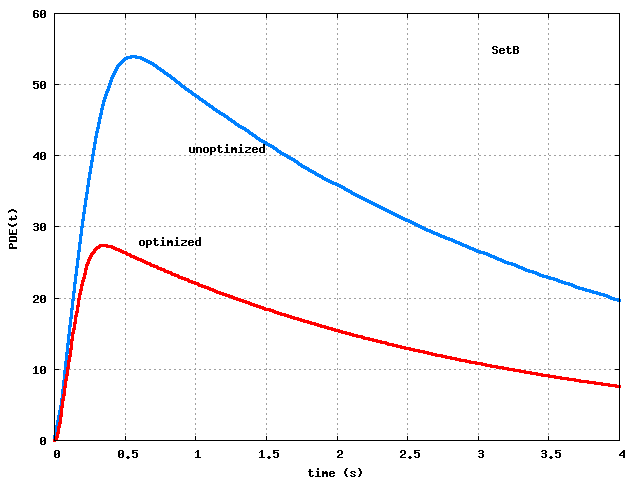
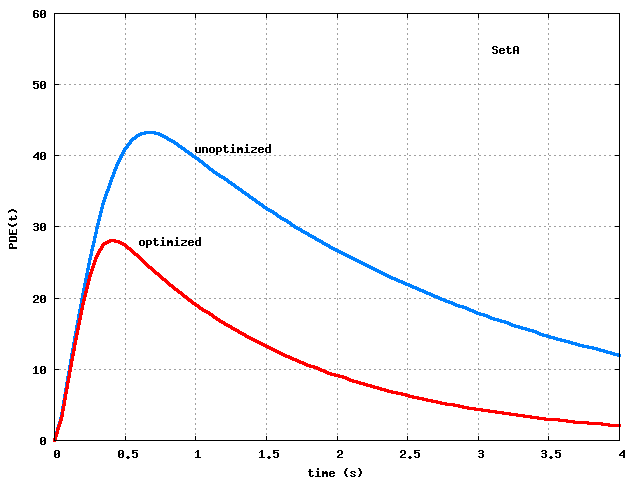
<mo stretchy="false">(</mo><mi>t</mi><mo stretchy="false">)</mo></mrow></math>&nbsp;we could find for SetA and SetB are plotted 
in Fig.<a href="#Fig:pkoptzd-PDE">1</a>, together with the 
<math xmlns="http://www.w3.org/1998/Math/MathML">
<mrow>
<msup><mrow><mi>PDE</mi></mrow><mrow><mo>*</mo></mrow>
</msup>
<mo stretchy="false">(</mo><mi>t</mi><mo stretchy="false">)</mo></mrow></math>&nbsp;generated
by the initial (unoptimized) parameter values.
Clearly, the optimization process has greatly improved the peak,
and both sets approximate well the target values 
<math xmlns="http://www.w3.org/1998/Math/MathML">
<mrow><mi>TGTpk</mi></mrow></math>, 
<math xmlns="http://www.w3.org/1998/Math/MathML">
<mrow><mi>TGTpktime</mi></mrow></math>. 

<div class="p"><!----></div>

<div class="p"><!----></div>
<a name="tth_fIg1"> 
</a> 
<table>
<tr><td align="center"> <!-- *0.32! -->
   <img src="Fig1a.png" height="220" width="340" alt="Fig1a.png" />
	<br /> 
   <a href="Fig1a.png"> Fig.1a</a> 
</td><td align="center"> <!-- *0.32! -->	
   <img src="Fig1b.png" height="220" width="340" alt="Fig1b.png" />
	<br /> 
   <a href="Fig1b.png"> Fig.1b</a> 
</td></tr>
</table>

<center>Figure 1: Step 3 optimization of SetA and SetB parameters:&nbsp;
<math xmlns="http://www.w3.org/1998/Math/MathML">
<mrow>
<msup><mrow><mi>PDE</mi></mrow><mrow><mo>*</mo></mrow>
</msup>
<mo stretchy="false">(</mo><mi>t</mi><mo stretchy="false">)</mo></mrow></math>&nbsp;curves.
Both sets approximate well the targeted peak 
	(
<math xmlns="http://www.w3.org/1998/Math/MathML">
<mrow><mi>TGTpk</mi><mo>=</mo><mn>27</mn></mrow></math>, 
<math xmlns="http://www.w3.org/1998/Math/MathML">
<mrow><mi>TGTpktime</mi><mo>=</mo><mn>0</mn><mo>.</mo><mn>4</mn></mrow></math>). 
</center><a name="Fig:pkoptzd-PDE">
</a>

<div class="p"><!----></div>

<div class="p"><!----></div>
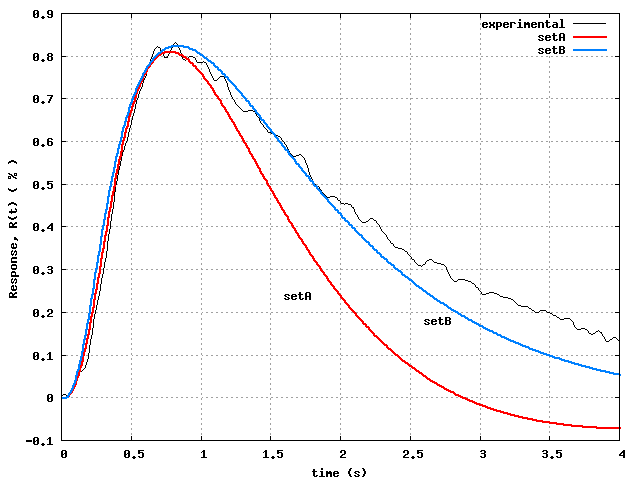
However, when we look at the resulting response curves, 
Fig.<a href="#Fig:pkoptzd-RR">2</a>, 
the peak-optimized parameters produce lousy overall response 
<math xmlns="http://www.w3.org/1998/Math/MathML">
<mrow><mrow><mstyle fontfamily="helvetica"><mi fontstyle="italic">R</mi></mstyle></mrow>
<mo stretchy="false">(</mo><mi>t</mi><mo stretchy="false">)</mo><mi>&nbsp;</mi></mrow></math> 
against the experimental data, even though they do well at the peak.

<div class="p"><!----></div>
<a name="tth_fIg2">
</a> 
<center> <!-- *0.4! -->	
 <img src="Fig2.png" height="220" width="340" alt="Fig2.png" /> 
	<br /> 
   <a href="Fig2.png"> Fig.2</a> 


<center>Figure 2: Step 3 optimization of SetA and SetB parameters: 
<math xmlns="http://www.w3.org/1998/Math/MathML">
<mrow><mi>&nbsp;</mi><mrow><mstyle fontfamily="helvetica"><mi fontstyle="italic">R</mi></mstyle></mrow>
<mo stretchy="false">(</mo><mi>t</mi><mo stretchy="false">)</mo><mi>&nbsp;</mi></mrow></math> curves.
Both sets do well at the peak but poorly afterwards.
</center><a name="Fig:pkoptzd-RR">
</a>
</center>

<div class="p"><!----></div>
Clearly, the strategy of optimizing to match only the peak is not sufficient.

<div class="p"><!----></div>
     <h3><a name="tth_sEc4.4">
4.4</a>&nbsp;&nbsp;
Step 4. <b><font size="+1">Optimization over the entire response history:</font></b> </h3>
The failure of the peak-only optimization makes it necessary
to optimize over the entire history of the data !
That's bad news, as there are too many data points 
(400, one every 10 msec), and the data curve 
(solid curve in Fig.<a href="#Fig:pkoptzd-RR">2</a>) is too wiggly.
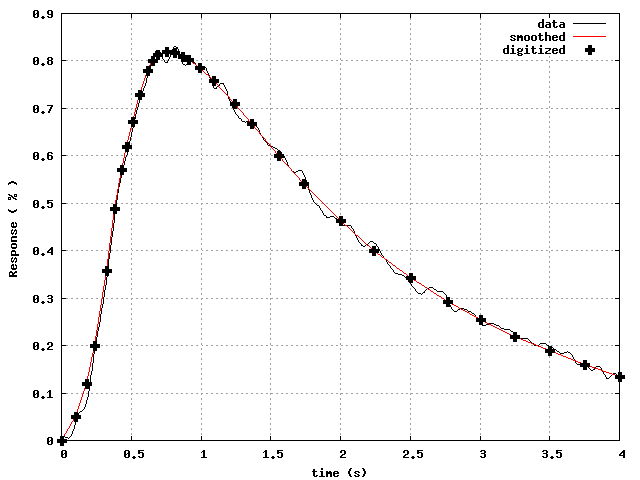
So, we first smoothed out the wiggly experimental data, and digitized 
the smoothed curve using only 32 time points, as shown in 
Fig.<a href="#Fig:smoothed">3</a>.

<div class="p"><!----></div>
<a name="tth_fIg3">
</a> 
<center> <!-- *0.45! -->
 <img src="Fig3.png" height="220" width="340" alt="Fig3.png" /> 
	<br /> 
   <a href="Fig3.png"> Fig.3</a> 


<center>Figure 3: Experimental data (wiggly curve), smoothed (dotted curve), and 
digitized using only 32 points.
</center><a name="Fig:smoothed">
</a>
</center>

<div class="p"><!----></div>

<div class="p"><!----></div>
These digitized  points were used as <b>
<math xmlns="http://www.w3.org/1998/Math/MathML">
<mrow>
<msub><mrow><mstyle fontfamily="helvetica"><mi fontstyle="italic">R</mi></mstyle></mrow>
<mrow><mi>tgt</mi></mrow>
</msub>
<mo stretchy="false">(</mo>
<msub><mrow><mi>t</mi></mrow><mrow><mi>k</mi></mrow>
</msub>
<mo stretchy="false">)</mo></mrow></math></b> points 
to minimize the L
<math xmlns="http://www.w3.org/1998/Math/MathML">
<mrow>
<msup><mrow></mrow><mrow><mn>2</mn></mrow>
</msup>
</mrow></math>-norm of 
<math xmlns="http://www.w3.org/1998/Math/MathML">
<mrow><mrow><mstyle fontfamily="helvetica"><mi fontstyle="italic">R</mi></mstyle></mrow>
<mo stretchy="false">(</mo>
<msub><mrow><mi>t</mi></mrow><mrow><mi>k</mi></mrow>
</msub>
<mo stretchy="false">)</mo><mo>-</mo><mo>Â</mo><mo>­</mo>
<msub><mrow><mstyle fontfamily="helvetica"><mi fontstyle="italic">R</mi></mstyle></mrow>
<mrow><mi>tgt</mi></mrow>
</msub>
<mo stretchy="false">(</mo>
<msub><mrow><mi>t</mi></mrow><mrow><mi>k</mi></mrow>
</msub>
<mo stretchy="false">)</mo></mrow></math>. 
In fact, we seek (influential) parameters 
<math xmlns="http://www.w3.org/1998/Math/MathML">
<mrow>
<msub><mrow><mi>p</mi></mrow><mrow><mn>1</mn></mrow>
</msub>
<mo>,</mo>
<msub><mrow><mi>p</mi></mrow><mrow><mn>2</mn></mrow>
</msub>
<mo>,</mo>
<msub><mrow><mi>p</mi></mrow><mrow><mn>3</mn></mrow>
</msub>
<mo>,</mo>
<msub><mrow><mi>p</mi></mrow><mrow><mn>4</mn></mrow>
</msub>
</mrow></math> 
that mininize the multi-objective cost function 
<a name="eq:min_RR">
</a><br />
<table width="100%"><tr><td align="center">
    <math xmlns="http://www.w3.org/1998/Math/MathML">
    <mstyle displaystyle="true"><mrow><mrow><mstyle fontfamily="helvetica"><mi fontstyle="italic">F</mi></mstyle></mrow>
<mo stretchy="false">(</mo><mi fontweight="bold">p</mi><mo stretchy="false">)</mo><mo>=</mo>
<munderover><mo>&sum;</mo><mrow><mi>k</mi><mo>=</mo><mn>1</mn> </mrow>
<mrow><mn>32</mn></mrow></munderover>
<msup><mrow><mo>[</mo><mn>1</mn><mo>-</mo><mrow><mstyle fontfamily="helvetica"><mi fontstyle="italic">R</mi></mstyle></mrow>
<mo stretchy="false">(</mo>
<msub><mrow><mi>t</mi></mrow><mrow><mi>k</mi></mrow>
</msub>
<mo stretchy="false">)</mo><mo stretchy="false">/</mo>
<msub><mrow><mstyle fontfamily="helvetica"><mi fontstyle="italic">R</mi></mstyle></mrow>
<mrow><mi>tgt</mi></mrow>
</msub>
<mo stretchy="false">(</mo>
<msub><mrow><mi>t</mi></mrow><mrow><mi>k</mi></mrow>
</msub>
<mo stretchy="false">)</mo><mo>]</mo></mrow><mrow><mn>2</mn></mrow>
</msup>
<mo>+</mo>
<msub><mrow><mi>w</mi></mrow><mrow><mn>1</mn></mrow>
</msub>

<msup><mrow><mo>[</mo><mn>1</mn><mo>-</mo>
<msub><mrow><mstyle fontfamily="helvetica"><mi fontstyle="italic">R</mi></mstyle></mrow>
<mrow><mi>peak</mi></mrow>
</msub>
<mo stretchy="false">/</mo><mi>TGTpk</mi><mo>]</mo></mrow><mrow><mn>2</mn></mrow>
</msup>
<mo>+</mo>
<msub><mrow><mi>w</mi></mrow><mrow><mn>2</mn></mrow>
</msub>

<msup><mrow><mo>[</mo><mn>1</mn><mo>-</mo>
<msub><mrow><mstyle fontfamily="helvetica"><mi fontstyle="italic">R</mi></mstyle></mrow>
<mrow><mi>pktime</mi></mrow>
</msub>
<mo stretchy="false">/</mo><mi>TGTpktime</mi><mo>]</mo></mrow><mrow><mn>2</mn></mrow>
</msup>
</mrow>
    </mstyle></math></td><td width="1">
    <math xmlns="http://www.w3.org/1998/Math/MathML">
    <mstyle displaystyle="true"><mrow><mo stretchy="false">(</mo><mn>3</mn><mo stretchy="false">)</mo></mrow>
    </mstyle></math>
</td></tr></table>


with target values 
<math xmlns="http://www.w3.org/1998/Math/MathML">
<mrow><mi>TGTpk</mi></mrow></math>, 
<math xmlns="http://www.w3.org/1998/Math/MathML">
<mrow><mi>TGTpktime</mi></mrow></math> now set to those of the 
experimental response (0.82% and 0.7 sec, respectively), and 
various weights 
<math xmlns="http://www.w3.org/1998/Math/MathML">
<mrow>
<msub><mrow><mi>w</mi></mrow><mrow><mn>1</mn></mrow>
</msub>
</mrow></math>&nbsp;, 
<math xmlns="http://www.w3.org/1998/Math/MathML">
<mrow>
<msub><mrow><mi>w</mi></mrow><mrow><mn>2</mn></mrow>
</msub>
</mrow></math>. 
Note that the response values 
<math xmlns="http://www.w3.org/1998/Math/MathML">
<mrow><mrow><mstyle fontfamily="helvetica"><mi fontstyle="italic">R</mi></mstyle></mrow>
<mo stretchy="false">(</mo>
<msub><mrow><mi>t</mi></mrow><mrow><mi>k</mi></mrow>
</msub>
<mo stretchy="false">)</mo></mrow></math>, 
<math xmlns="http://www.w3.org/1998/Math/MathML">
<mrow><mi>k</mi><mo>=</mo><mn>1</mn><mo>,</mo><mo>.</mo><mo>.</mo><mo>.</mo><mn>32</mn></mrow></math>, 
as well as peak value, 
<math xmlns="http://www.w3.org/1998/Math/MathML">
<mrow>
<msub><mrow><mstyle fontfamily="helvetica"><mi fontstyle="italic">R</mi></mstyle></mrow>
<mrow><mi>peak</mi></mrow>
</msub>
</mrow></math>, and the time it occurs,

<math xmlns="http://www.w3.org/1998/Math/MathML">
<mrow>
<msub><mrow><mstyle fontfamily="helvetica"><mi fontstyle="italic">R</mi></mstyle></mrow>
<mrow><mi>pktime</mi></mrow>
</msub>
</mrow></math>, 
are functions of the parameters 
<math xmlns="http://www.w3.org/1998/Math/MathML">
<mrow><mi fontweight="bold">p</mi></mrow></math>, in particular of 

<math xmlns="http://www.w3.org/1998/Math/MathML">
<mrow>
<msub><mrow><mi>p</mi></mrow><mrow><mn>1</mn></mrow>
</msub>
<mo>,</mo>
<msub><mrow><mi>p</mi></mrow><mrow><mn>2</mn></mrow>
</msub>
<mo>,</mo>
<msub><mrow><mi>p</mi></mrow><mrow><mn>3</mn></mrow>
</msub>
<mo>,</mo>
<msub><mrow><mi>p</mi></mrow><mrow><mn>4</mn></mrow>
</msub>
</mrow></math> over which we are optimizing, and they can only
be found by running the <i>cascade code</i>.

<div class="p"><!----></div>
The NEWUOA optimization code is efficient and typically uses 
fewer than 100 evaluations of the cost function 
<math xmlns="http://www.w3.org/1998/Math/MathML">
<mrow><mrow><mstyle fontfamily="helvetica"><mi fontstyle="italic">F</mi></mstyle></mrow>
<mo stretchy="false">(</mo><mi fontweight="bold">p</mi><mo stretchy="false">)</mo></mrow></math>, for 
tolerance set to 2&nbsp;%.

<div class="p"><!----></div>
The multi-objective cost function 
<math xmlns="http://www.w3.org/1998/Math/MathML">
<mrow><mrow><mstyle fontfamily="helvetica"><mi fontstyle="italic">F</mi></mstyle></mrow>
<mo stretchy="false">(</mo><mi fontweight="bold">p</mi><mo stretchy="false">)</mo></mrow></math>, natural as it is
for the problem, is far from ideal, unfortunately.
It turns out that many 
<math xmlns="http://www.w3.org/1998/Math/MathML">
<mrow><mi fontweight="bold">p</mi></mrow></math> can produce about the same value for 

<math xmlns="http://www.w3.org/1998/Math/MathML">
<mrow><mrow><mstyle fontfamily="helvetica"><mi fontstyle="italic">F</mi></mstyle></mrow>
<mo stretchy="false">(</mo><mi fontweight="bold">p</mi><mo stretchy="false">)</mo></mrow></math>,
and the starting 
<math xmlns="http://www.w3.org/1998/Math/MathML">
<mrow><mi fontweight="bold">p</mi></mrow></math> is crucial, a nightmare for optimization.
Apparently, the landscape of 
<math xmlns="http://www.w3.org/1998/Math/MathML">
<mrow><mrow><mstyle fontfamily="helvetica"><mi fontstyle="italic">F</mi></mstyle></mrow>
<mo stretchy="false">(</mo><mi fontweight="bold">p</mi><mo stretchy="false">)</mo></mrow></math> is extremely "bumpy", 
with multiple, shallow, local minima. 
Moreover, it is very hard to drive 
<math xmlns="http://www.w3.org/1998/Math/MathML">
<mrow>
<msub><mrow><mstyle fontfamily="helvetica"><mi fontstyle="italic">R</mi></mstyle></mrow>
<mrow><mi>pktime</mi></mrow>
</msub>
</mrow></math> lower (desirable),
and the last two terms in 
<math xmlns="http://www.w3.org/1998/Math/MathML">
<mrow><mrow><mstyle fontfamily="helvetica"><mi fontstyle="italic">F</mi></mstyle></mrow>
<mo stretchy="false">(</mo><mi fontweight="bold">p</mi><mo stretchy="false">)</mo></mrow></math> seem to antagonize 
each other; parameters that would lower 
<math xmlns="http://www.w3.org/1998/Math/MathML">
<mrow>
<msub><mrow><mstyle fontfamily="helvetica"><mi fontstyle="italic">R</mi></mstyle></mrow>
<mrow><mi>pktime</mi></mrow>
</msub>
</mrow></math> also
drive 
<math xmlns="http://www.w3.org/1998/Math/MathML">
<mrow>
<msub><mrow><mstyle fontfamily="helvetica"><mi fontstyle="italic">R</mi></mstyle></mrow>
<mrow><mi>peak</mi></mrow>
</msub>
</mrow></math> away from the target value.
Under the circumstances, the choice 
<math xmlns="http://www.w3.org/1998/Math/MathML">
<mrow>
<msub><mrow><mi>w</mi></mrow><mrow><mn>1</mn></mrow>
</msub>
<mo>=</mo><mn>1</mn></mrow></math>, 
<math xmlns="http://www.w3.org/1998/Math/MathML">
<mrow>
<msub><mrow><mi>w</mi></mrow><mrow><mn>2</mn></mrow>
</msub>
<mo>=</mo><mn>5</mn></mrow></math> for weights 
seems to do better than other combinations, yet leaves a lot to be
desired.

<div class="p"><!----></div>
As in the peak-only case of Step 3, there is high degree of 
non-uniqueness, and the values that minimize 
<math xmlns="http://www.w3.org/1998/Math/MathML">
<mrow><mrow><mstyle fontfamily="helvetica"><mi fontstyle="italic">F</mi></mstyle></mrow>
<mo stretchy="false">(</mo><mi fontweight="bold">p</mi><mo stretchy="false">)</mo></mrow></math> 
were usually not the best.
So, again, we used the optimizer as landscape explorer, by
printing out all the iterates to find (by inspection) those with best 
combination of 
<math xmlns="http://www.w3.org/1998/Math/MathML">
<mrow>
<msub><mrow><mstyle fontfamily="helvetica"><mi fontstyle="italic">R</mi></mstyle></mrow>
<mrow><mi>peak</mi></mrow>
</msub>
<mo stretchy="false">(</mo><mi fontweight="bold">p</mi><mo stretchy="false">)</mo></mrow></math> and 
<math xmlns="http://www.w3.org/1998/Math/MathML">
<mrow>
<msub><mrow><mstyle fontfamily="helvetica"><mi fontstyle="italic">R</mi></mstyle></mrow>
<mrow><mi>pktime</mi></mrow>
</msub>
<mo stretchy="false">(</mo><mi fontweight="bold">p</mi><mo stretchy="false">)</mo></mrow></math>,
and then looking at the overall fit to the data.

<div class="p"><!----></div>
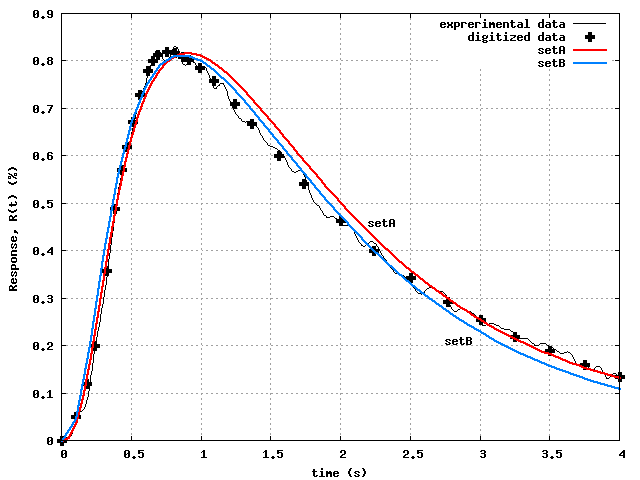
Fig.<a href="#Fig:SetAB">4</a> shows the best results we could obtain, after 
many tries with various combinations of weights, tolerances, 
and combinations of Step 3 and Step 4 optimizations. In fact,
the SetA curve was obtained by Step 4 optimization applied to the 
Step 3 optimized SetA parameters, whereas the SetB curve was obtained 
directly by Step 4 optimization of the unoptimized SetB parameters.
Considering the extreme natural variability of biological data,
the agreement of both SetA and SetB response curves with the
experimental data is very good.

<div class="p"><!----></div>
Although both SetA and SetB do comparably well in capturing the
data, their optimized parameters are quite different, exhibiting the 
severe non-uniqueness of the parameter estimation problem.
For example, the 
<math xmlns="http://www.w3.org/1998/Math/MathML">
<mrow>
<msub><mrow><mi>p</mi></mrow><mrow><mn>1</mn></mrow>
</msub>
<mo>,</mo>
<msub><mrow><mi>p</mi></mrow><mrow><mn>2</mn></mrow>
</msub>
<mo>,</mo>
<msub><mrow><mi>p</mi></mrow><mrow><mn>3</mn></mrow>
</msub>
<mo>,</mo>
<msub><mrow><mi>p</mi></mrow><mrow><mn>4</mn></mrow>
</msub>
</mrow></math> optimized values of SetA are
347 , 618 , 0.258 , 0.051, while those of SetB are
190 , 741 , 0.279 , 0.108.
Viewed from another perspective, perhaps the values are not that
different.
A range of values for each parameter is perhaps the best one can
hope to determine on the basis of indirect biological data.

<div class="p"><!----></div>
<a name="tth_fIg4">
</a> 
<center> <!-- *0.60! -->
 <img src="Fig4.png" height="220" width="340" alt="Fig4.png" /> 
	<br /> 
   <a href="Fig4.png"> Fig.4</a> 


<center>Figure 4: Response from optimized SetA and SetB parameters, compared with 
the experimental data and the 32 digitized data points used in optimization.
</center><a name="Fig:SetAB">
</a>
</center>

<div class="p"><!----></div>

<div class="p"><!----></div>

 <h2><a name="tth_sEc5">
5</a>&nbsp;&nbsp;CONCLUSION</h2><a name="S:5">
</a> 
We discussed parameter estimation by fitting to experimental data
for phototransduction in rod photoreceptors of vertebrates.
This is a typical inverse (ill-posed) problem of parameter 
identification that can be viewed as a multi-objective optimization 
problem.  The difficulties encountered and procedures to overcome 
them were presented. 

<div class="p"><!----></div>
The difficulties include: large parameter space, highly nonlinear
dependence of quantities of interest on the sought parameters,
lack of good starting values, and high degree of non-uniqueness.

<div class="p"><!----></div>
We employed statistical uncertainty and sensitivity analysis
(using the excellent <b>SimLab</b> software package), 
to scope out the parameter space, 
to reduce the number of parameters to only the most influential ones, 
and to find "promising" starting parameter values for the subsequent 
multi-objective optimization problem. 
The ambiguities and pitfalls were pointed out.
The fact that quantities of interest can only be found via
simulation (running the forward model) necessitates using
an efficient, derivative-free optimizer. Powell's NEWUOA fulfills
these requirements. 

<div class="p"><!----></div>
Although natural for the problem, the multi-objective cost function 

<math xmlns="http://www.w3.org/1998/Math/MathML">
<mrow><mrow><mstyle fontfamily="helvetica"><mi fontstyle="italic">F</mi></mstyle></mrow>
<mo stretchy="false">(</mo><mi fontweight="bold">p</mi><mo stretchy="false">)</mo></mrow></math> is far from ideal.  Its landscape seems to be 
extremely "bumpy", with multiple, shallow, local minima. 
Thus we resorted to using the optimizer as landscape explorer, by
printing out the iterates to find (by inspection) those with best 
combination of 
<math xmlns="http://www.w3.org/1998/Math/MathML">
<mrow>
<msub><mrow><mstyle fontfamily="helvetica"><mi fontstyle="italic">R</mi></mstyle></mrow>
<mrow><mi>peak</mi></mrow>
</msub>
<mo stretchy="false">(</mo><mi fontweight="bold">p</mi><mo stretchy="false">)</mo></mrow></math> and 
<math xmlns="http://www.w3.org/1998/Math/MathML">
<mrow>
<msub><mrow><mstyle fontfamily="helvetica"><mi fontstyle="italic">R</mi></mstyle></mrow>
<mrow><mi>pktime</mi></mrow>
</msub>
<mo stretchy="false">(</mo><mi fontweight="bold">p</mi><mo stretchy="false">)</mo></mrow></math>,
and then looking at the overall fit to the data.

<div class="p"><!----></div>
Despite the severe non-uniqueness and other difficulties encountered, 
the approach turned out to be successful and we did find parameter 
sets producing responses in good agreement with the available
experimental data. By biological standards, the agreement seen in
Fig.<a href="#Fig:SetAB">4</a> could be considered 'excellent'.

<div class="p"><!----></div>

<div class="p"><!----></div>
<h2>References</h2>

<dl compact="compact">
 <dt><a href="#CITEbb:Bionets" name="bb:Bionets">[1]</a></dt><dd> 
D Adalsteinsson, D McMillen, and TC Elston,
<i>Biochemical Network Stochastic Simulator (BioNetS)</i>,  
BMC Bioinformatics 5 (24) (2004) www.biomedcentral.com/14712105/5/24.
</dd>
 <dt><a href="#CITEbb:multiphoton07" name="bb:multiphoton07">[2]</a></dt><dd> 
V Alexiades and H Khanal,
<i>Multiphoton Response of Retinal Rod Photoreceptors</i>,
Electron. J. Diff. Eqns, Conf. 15 (2007) 1-9.
</dd>
 <dt><a href="#CITEbb:Caruso05" name="bb:Caruso05">[3]</a></dt><dd> 
G Caruso, H Khanal, V Alexiades, F Rieke, HE Hamm, and E DiBenedetto,
<i>Mathematical and Numerical Modeling of SpatioTemporal Signaling 
in Rod Phototransduction</i>,
IEE Proc. Systems Biology, 152(3) (2005) 119137.
</dd>
 <dt><a href="#CITEbb:incisures06" name="bb:incisures06">[4]</a></dt><dd> 
G Caruso, P Bisegna, L Shen, D Andreucci, HE Hamm, and E DiBenedetto,
<i>The Role of Incisures in Phototransduction in Vertebrate Photoreception</i>,
Biophysical J., 91 (2006) 1192-1212.
</dd>
 <dt><a href="#CITEbb:Dizzy06" name="bb:Dizzy06">[5]</a></dt><dd> 
<i>Dizzy: chemical kinetics stochastic simulator in Java</i>,  
version 1.11.3 2006/04/18,
Institute for Systems Biology, Seattle WA,
http://magnet.systemsbiology.net/software/Dizzy/
</dd>
 <dt><a href="#CITEbb:GrayKeller99" name="bb:GrayKeller99">[6]</a></dt><dd> 
M Gray-Keller, W Denk, B Shraiman, and PB Detwiler,
<i>Longitudinal spread of second messenger signals in isolated rod 
outer segments of lizards</i>,
J. Physiology 519(3) (1999) 679-692.
</dd>
 <dt><a href="#CITEbb:Hamer03" name="bb:Hamer03">[7]</a></dt><dd> 
RD Hamer, SC Nicholas, D Trachina, PA Liebman, and TD Lamb,
<i>Multiple steps of phosphorylation of activated rhodopsin can 
account for the reproducibility of vertebrate rod single-photon response</i>, 
J. Gen. Physiology 122 (2003) 419-444.
</dd>
 <dt><a href="#CITEbb:Khanal04" name="bb:Khanal04">[8]</a></dt><dd> 
H Khanal, V Alexiades, and E DiBenedetto,
<i>Response of Dark-adapted Retinal Rod Photoreceptors</i>,
pp.138-145 in <b>Dynamic Systems and Applications 4</b>,
editor M Sambandham, Dynamic Publishers, 2004.
</dd>
 <dt><a href="#CITEbb:Khanal07" name="bb:Khanal07">[9]</a></dt><dd> 
H Khanal and V Alexiades, 
<i>Models of Phototransduction in Rod Photoreceptors</i>,
in <b>Dynamic Systems and Applications 5</b>,
editor M Sambandham, Dynamic Publishers, 2008 (this volume).
</dd>
 <dt><a href="#CITEbb:Patton04" name="bb:Patton04">[10]</a></dt><dd> 
Torry Patton,
<i>Modeling the Cascade of Reactions in Visual Transduction</i>, 
MS Thesis, Mathematics Dept, University of Tennessee, Aug. 2004.
</dd>
 <dt><a href="#CITEbb:Powell" name="bb:Powell">[11]</a></dt><dd> 
TJM Powell,
<i>The NEWUOA software for unconstrained optimization without 
derivatives</i>, Report DAMTP 2004/NA08, Cambridge University, 2004.
</dd>
 <dt><a href="#CITEbb:PL2000" name="bb:PL2000">[12]</a></dt><dd> 
EN Pugh Jr. and TD Lamb,
<i>Phototransduction in Vertebrate Rods and Cones</i>,  
Chapter 5, in DG Stavenga, WJ de Grip and EN Pugh Jr. (eds),
Handbook of Biological Physics, Vol. 3, pp.183-254. Elsevier 2000.
</dd>
 <dt><a href="#CITEbb:Ramsey05" name="bb:Ramsey05">[13]</a></dt><dd> 
S Ramsey, D Orrell, and H Bolouri,
<i>Dizzy: stochastic simulation of large-scale genetic regulatory networks</i>,  
J Bioinform Comput Biol. 3(2) (2005) 415-436.
</dd>
 <dt><a href="#CITEbb:Saltelli04" name="bb:Saltelli04">[14]</a></dt><dd> 
A Saltelli, S Tarantola, F Campolongo, and M Ratto,
<b>Sensitivity analysis in practice: a guide to assessing scientific 
models</b>, Wiley, 2004.
</dd>
 <dt><a href="#CITEbb:SimLab" name="bb:SimLab">[15]</a></dt><dd> 
<i>SimLab 2.2: Simulation environment for uncertainty and sensitivity 
analysis</i>, 
Joint Research Centre, European Commission, 
http://simlab.jrc.cec.eu.int/

<div class="p"><!----></div>
</dd>
</dl>
<div class="p"><!----></div>
<a name="lastpage">
</a> 
<div class="p"><!----></div>

<br /><br /><hr /><small>File translated from
T<sub><font size="-1">E</font></sub>X
by <a href="http://hutchinson.belmont.ma.us/tth/">
T<sub><font size="-1">T</font></sub>M</a>,
version 3.72.<br />On 19 Aug 2007, 23:31.</small>
</body></html>